


Blog
Self-managed trust accounts, virtual wallets and automated trust models: what’s the difference?
As trust accounting has evolved, the scope of transactions handled through trust accounts has expanded, increasing both operational complexity and compliance responsibility.
- February 6, 2026
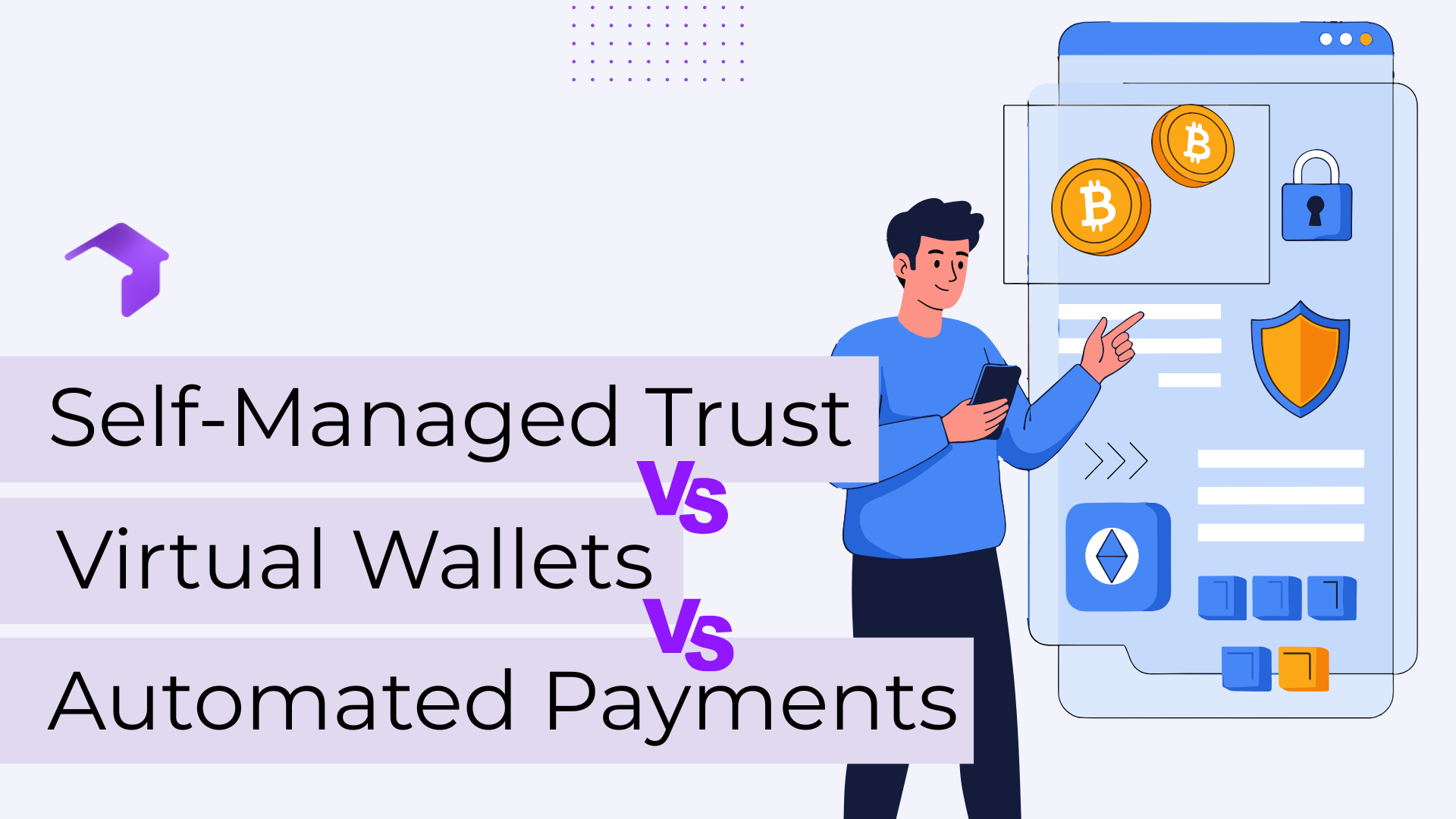
Self-managed trust accounts, virtual wallets and automated trust models: what’s the difference?
Trust accounting is one of the most important responsibilities in property management. Every rent payment, invoice and owner disbursement passes through it, and with that comes significant regulatory and financial accountability.
As trust accounting has evolved, the scope of transactions handled through trust accounts has expanded, increasing both operational complexity and compliance responsibility. This now commonly includes not just tenant rent, but owner contributions, trade invoices and refunds and insurance-related payments.
Today, agencies are faced with multiple ways to manage trust money. While these options are often described using similar language, they operate very differently in practice. Understanding those differences is critical when considering compliance obligations, operational risk and long-term growth.
By the end of this article, you will have clearer context and a practical understanding of how the three main trust models work today, so you can make informed decisions about what is right for your agency now and in the future.
The three most common approaches are:
- Self-managed trust accounts
- Virtual wallet models
- Fully automated, regulated trust accounts
Self-managed trust accounts
Control sits with the agency (along with compliance and risk)
A self-managed trust account is the traditional model most agencies have operated under for decades.
Under this approach:
- Tenant rent is paid into an agency-held trust account
- Payments are manually receipted and recorded
- Agency fees are calculated and transferred manually
- Invoices are authorised and paid by staff
- Landlord disbursements are prepared and processed internally
- Reconciliation, reporting and audit preparation sit entirely with the agency
This model gives agencies direct control over trust funds, but it also places full responsibility for accuracy, compliance and audit readiness on the business.
What this means operationally
In practice, a self-managed trust account requires constant attention.
Agencies must:
- Receipt and reconcile payments daily
- Investigate unidentified deposits
- Prepare disbursements and statements
- Manage timing differences between rent received and bills due
- Prepare for audits and respond to audit findings
As transaction volumes increase, the margin for error narrows. What may feel manageable at a smaller scale often becomes increasingly difficult as portfolios grow, staff change and regulatory requirements evolve.
In this model, scale is achieved by adding people or hours.
Virtual wallet models
Funds move, responsibility often does not
Virtual wallet models introduce a different structure for holding and moving funds.
Under a virtual wallet model:
- Funds are held in individual tenant or landlord wallets, which are intended to be owned by the tenant or owner rather than the agency
- Payments flow between wallets rather than through a regulated trust account
- At no stage do funds pass through an account controlled by the agency
- Automation is typically dependent on sufficient funds being available in the relevant wallet
- Agencies may still need to operate a traditional trust account for certain payment scenarios
Because virtual wallets are not trust accounts:
- They are not subject to trust account audits
- Trust-account specific protections, such as fidelity guarantees, do not apply in the same way
- Payment timing and statement timing can be difficult to align
- Manual intervention may still be required where funds are insufficient
- Compliance responsibilities may remain partially with the agency, depending on jurisdiction and use case
Wallet models can simplify specific payment interactions, particularly around rent collection. However, they do not remove the broader financial oversight required in property management. In many cases, agencies find themselves operating wallet workflows alongside a traditional trust account, which can introduce additional complexity rather than reduce it.
Virtual wallets change where money sits, but they do not fundamentally change how trust risk is managed.
Fully automated trust accounts
The trust account still exists, but the work moves away from the agency
A fully automated trust model combines regulatory structure with automation.
Under this model:
- All funds are held in a regulated trust account
- Rent, invoices, fees and disbursements are processed automatically
- Payments are receipted and allocated without manual input
- Reconciliation can occur multiple times throughout the day (as is the case with OurProperty)
- Landlord disbursements follow predefined rules and schedules
- Statements and reports are generated automatically
Critically, the trust account itself is operated and audited as part of the platform, rather than by the agency.
How this changes the risk profile
Trust accounting carries inherent risks around compliance, accuracy and security. In manual and semi-automated models, these risks are managed through process and oversight.
An automated trust model manages risk structurally.
- Compliance: Regulatory rules are built into the system, reducing reliance on individual knowledge and manual checks.
- Accuracy: Automated receipting and reconciliation remove many of the common causes of human error.
- Security: Centralised controls and audit trails reduce exposure to fraud and misuse.
- Scale: Transaction volume increases without a corresponding increase in administrative workload.
The result is not just faster processing, but greater consistency and predictability across the entire trust operation.
The changing role of the trust accountant
Automation does not remove the need for financial expertise. It changes how that expertise is applied.
In an automated trust model, trust accountants and accounts teams are no longer consumed by repetitive operational tasks such as daily receipting, manual reconciliation and audit preparation. Instead, their role shifts toward oversight, analysis and support.
This often includes:
- Managing exceptions and complex scenarios rather than routine transactions
- Supporting property managers and owners with informed, timely financial insight
- Reviewing statements and ledgers to identify issues quickly and confidently
- Improving processes rather than maintaining manual workflows
- Strengthening controls and oversight across trust activity
With greater visibility into trust movements, trust accountants are also able to spend more time on work that supports the broader business, such as:
- Budgeting and cashflow planning
- Capacity planning and forecasting
- Identifying trends that impact growth and resourcing
- Supporting business decisions with accurate financial information
This shift allows experienced professionals to operate at a higher level, reduce burnout and contribute more meaningfully to the stability and growth of the agency.
A practical comparison
The comparison below highlights how responsibility, automation and compliance are handled differently across each model. While all three approaches can support rent collection, they distribute risk, effort and oversight in very different ways.
| Area | Self-managed trust | Virtual wallet | Automated trust |
|---|---|---|---|
| Rent receipting | Manual | Wallet-based | Automatic |
| Trust account | Agency-held | Not applicable | Platform-held |
| Reconciliation | Manual | Partial | Fully automated |
| Fees and withholdings | Manual | Limited | Automatic |
| Bill payments | Manual | Conditional | Automatic |
| Disbursements | Manual | Wallet-based | Automated and scheduled |
| Audit responsibility | Agency | Not audited | Platform audited |
| Scalability | Limited | Moderate | High |
Learn from agencies who’ve made the switch
Changing trust models is a significant decision. For many agencies, it involves unlearning long-standing processes and adapting to a new way of working.
What we consistently hear is that while there is a learning curve, agencies are supported closely through the transition and quickly begin to see the benefits in day-to-day operations.
Across Australia, agencies who have made the switch report improvements in efficiency, confidence and capacity.
RE/MAX Success
Daniel Burrett, General Manager
For Daniel’s team, removing the burden of audit preparation and oversight meant fewer interruptions to the business and greater confidence that trust processes were being handled correctly in the background.
Ray White Kim Olsen
Gary Olsen, Co-Owner
Before making the switch, the team were managing trust accounting and invoicing through highly manual workflows. Invoices, water, rates and trust receipting all required staff to enter and reconcile information across multiple systems.
After transitioning to an automated trust model, the agency saw faster owner payments as funds cleared, fewer repetitive tasks and the ability for a smaller team to manage a growing portfolio without added pressure.
McGrath Aspley
Clare McGrath, Business Owner
For Clare, trust accounting had long been one of the most time-consuming parts of the role.
By automating trust accounting and invoicing, tasks such as receipting, reconciliation and processing rates and water bills now occur automatically. What once required constant attention now runs quietly in the background, freeing the team to focus on higher-value work and client support.
Interested to learn more about our customers who have made the switch? Visit our Customer Stories.
Choosing a trust model that supports growth and scale
When assessing trust models, it is worth looking beyond immediate efficiency gains and considering how each option supports your business over time.
Questions many agency owners ask include:
- How easily does this model scale as our portfolio grows?
- Where does compliance responsibility sit as regulations change?
- How much manual oversight will still be required?
- Does this model reduce risk or simply move it?
A trust model that works today should also support where your business is heading, whether that involves growth, diversification or simply operating with less pressure.
See what your future could look like
For many agencies, the move to an automated trust model is less about technology and more about creating a simpler and more sustainable way of operating.
If you would like to understand how an automated trust account could work for your agency, the best next step is to see it in action.
Book a demo to explore how automated trust accounting works day to day and how agencies across Australia have made the transition with confidence.
Sometimes the biggest improvement is not doing things faster. It is removing the work altogether.
- All Posts
- Blog
A lease is more than a document. It's the operational blueprint for the entire tenancy. The lease sets the rules....
Property maintenance is about more than repairs. Learn how Ava helps property managers manage approvals, trades, communications and owner expectations...
Property management payments can look simple on the surface.